
Canary Cages: Why Length Matters More Than Height
When you walk into a pet store looking for a home for your new companion, your eyes naturally drift toward tall, ornate cages with domes, gothic arches, and gold-plated bars. These cages look grand, almost like palaces meant to reflect the noble song of the canary. However, in the world of professional aviculture, these "palaces" are often prisons that directly harm the bird.
As emphasized in our guide for canary beginners, proper housing isn't just an aesthetic choice—it’s a matter of health, longevity, and song quality. The Canary (Serinus canaria) is not an ornament; it is a small-scale elite athlete whose physiology demands specific conditions. In this guide, we will analyze every aspect of housing, from flight aerodynamics to the psychological impact of space on vocal performance.
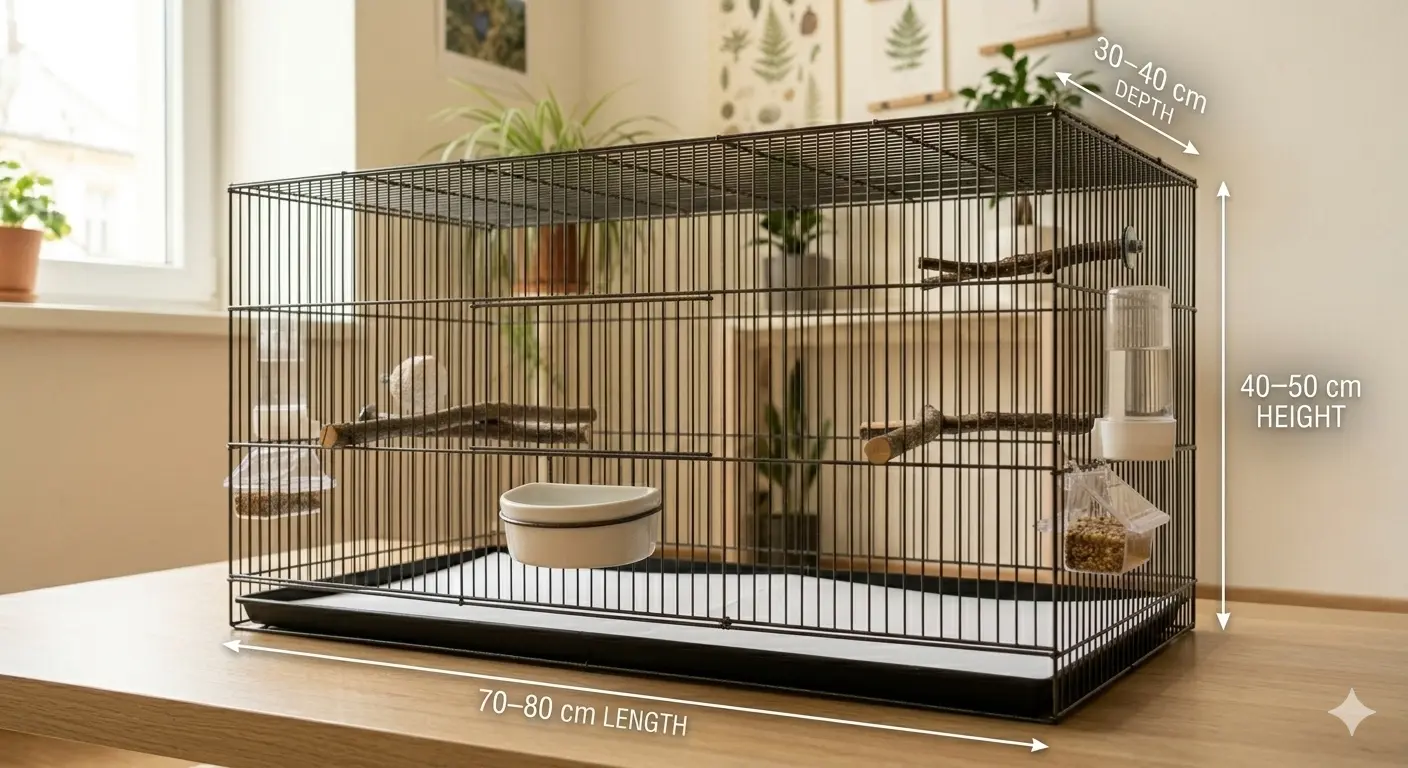
Ideal Canary Cage Dimensions
If you are looking for a direct answer on how big a canary cage should be, these are the gold standards every owner should follow:
- Minimum Length: 20 inches (50 cm) — the absolute minimum for one bird.
- Recommended Length: 28–32 inches (70–80 cm) — for optimal health and flight.
- Height: 16–20 inches (40–50 cm) — anything taller is unnecessary.
- Depth: 12–16 inches (30–40 cm) — enough for a full wing-turn.
Remember: For canaries, every extra inch of length directly contributes to their physical fitness and the quality of their song.
Physiology and Aerodynamics: A Canary is Not a Parrot
The first and most important lesson is that canaries and parrots move in completely different ways. Parrots are "climbers." They use their powerful beaks as a third foot, moving vertically up bars and enjoying high spaces where they can hang upside down.
Canaries, on the other hand, are strictly flyers. Their anatomy is designed for horizontal movement. In the wild, canaries inhabit open spaces, forest edges, and meadows where they fly from bush to bush. Their flight is straight and fast.
Why Height is Deceptive
In a tall, narrow cage, a canary can only hop from one perch to another, moving vertically like a helicopter. This movement does not engage the chest muscles (pectoralis major) correctly. Without the ability to take at least three to four full wing flaps in one direction, a canary loses muscle tone. The result is a physically weak bird, prone to obesity, and most importantly for owners—a bird that loses the will to sing.
Space, the Respiratory System, and Song
A canary’s song isn't just a product of "good mood." It is the result of peak physical condition. Canaries have one of the most complex vocal organs in nature—the syrinx. To produce those long, vibrant tours and trills, a canary must have strong lungs and an efficient air sac system.
When a bird flies horizontally, it forces its respiratory system to work at full capacity. This "cardio workout" strengthens the air sac walls and allows the bird to take in larger amounts of oxygen, which manifests directly through a stronger, steadier, and longer canary song. A male living in a small, tall cage quickly runs out of breath; his song tours become shorter, and his voice loses volume.
Choosing the Right Cage Size
If you want your canary to live 10 to 15 years, stop thinking of the cage as a piece of furniture. Think of it as a habitat.
Length is King
For a single canary, the absolute minimum is 20 inches in length. However, our recommendation for anyone wanting top results is a cage 28 to 32 inches long. In such a space, the bird can reach full flight speed before landing on the opposite perch.
Height and Width
The cage height should not exceed 18–20 inches. Why? Because canaries naturally gravitate toward the highest perch. If the cage is too tall, the bird will spend 90% of its time in the top 4 inches, while the bottom part sits empty, merely collecting droppings. The width (depth) should be about 12–16 inches, enough for the bird to spread its wings and turn without hitting the bars.
Best Canary Cages: What to Buy vs. What to Avoid
1. Decorative (Tower) Cages - AVOID
These cages are taller than they are long, often featuring ornate roofs. Besides being non-functional for flight, they are a nightmare to clean. Odd angles become breeding grounds for mites and bacteria.
2. Round Cages - STRICTLY FORBIDDEN
Round cages are the most inhumane invention in the bird world. Birds, like humans, need corners to feel secure. In a round cage, the bird has no "back-to-the-wall" reference point, leading to chronic stress and neurotic behavior. Additionally, bars taper at the top, where a bird can easily catch a toe or leg.
3. Rectangular "Flight Cages" - IDEAL
These are simple, long cages with flat tops. They maximize flight space and make it easy to set up equipment.
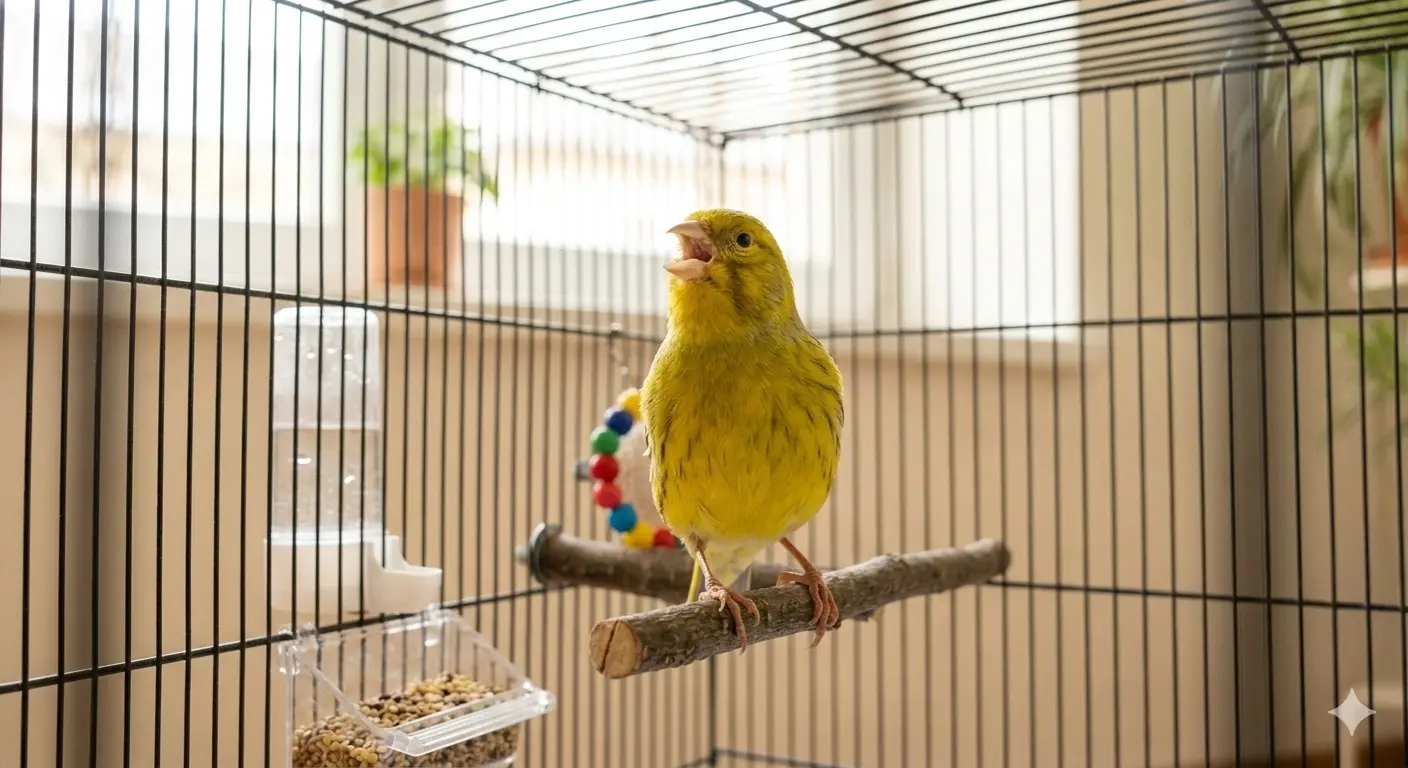
Equipping Your Canary Flight Cage
Even a 32-inch cage is useless if the interior looks like a cluttered closet. When setting up a canary's home, remember: Less is more.
Perch Placement
The main purpose of a long cage is flight. Therefore, place only two perches, one at each end of the cage. This leaves the middle area open as an "air corridor." If you put a perch in the middle, the bird will just hop instead of flying.
- Material: Use natural branches like willow, hazel, or apple wood. Varying thicknesses exercise the canary's feet, which is the best prevention for arthritis.
- Position: Ensure perches are not directly above food or water bowls to prevent contamination from droppings.
Light and Hormones: The Secret Key to Song
Many owners overlook the fact that canaries "sing with light." Their endocrine system is directly linked to the photoperiod (day length).
If you keep the cage in a room where artificial lights go on at 6 AM and off at midnight, the bird enters a state of constant stress. This leads to "false molting" and the cessation of song. Ideally, the cage should be in a room with natural light. If using artificial lights, use a timer to simulate a natural sunrise and sunset.
The "Safe Zone" Psychology
The Wall Rule
The cage should always have at least one side against a wall. A bird that feels exposed from all sides stays in a constant state of "high alert." When a canary knows no one can approach from behind, it relaxes, sleeps deeper, and sings more energetically.
Placement Height
Never keep the cage on the floor. The ideal height is at eye level or slightly above. In nature, danger comes from below, while safety is found high in the branches. A bird looking down on its environment feels secure.
Hygiene and Maintenance
- Cage Bottom: Use plain newspaper (avoid glossy ads) or specialized bird sand with crushed shells. Paper is excellent because it allows you to monitor droppings daily—the first indicator of bird health.
- Weekly Cleaning: Once a week, wash the perches and wipe down the bars with warm water and apple cider vinegar. Avoid harsh household chemicals; bird lungs are extremely sensitive to fumes.
FAQ
Is a 40-inch cage too big for one canary? Never! The longer the cage, the healthier your bird will be and the longer it will live.
Why is my canary sleeping on one leg? This is a sign of absolute trust and good health. Birds tuck one leg into their feathers to conserve body heat.
Can I keep a canary and a budgie in the same flight cage? No. Budgies are parrots; they can be aggressive and their powerful beaks can easily injure a canary's delicate legs.
How often should I replace natural perches? As soon as they become soiled or when the bird has stripped all the bark off them.
Conclusion: An Investment in Song
Buying a cage is a decision you make once, but your canary lives with that decision every second of its life. You can spend money on decorations or gold-plated wires, but the true value is in unobstructed space.
A long flight cage, natural branches, and the right room placement are all your singer needs. When you provide a "runway" for flight instead of a narrow tower, your bird will repay you with health, energy, and a song that fills every corner of your home.
