Masked Lovebirds - How to Identify Purebreds and Mask Specifics
In the world of bird enthusiasts, Agapornis personatus represents the pinnacle of aesthetic contrast. While other members of the Agapornis (lovebird) genus are often defined by soft transitions of pastel colors, the Masked Lovebird is a bird that knows no compromise. Its appearance is graphically precise: a dark, charcoal-black head that abruptly ends to give way to a bright, sun-yellow collar.
However, maintaining a purebred line of Masked Lovebirds in captivity has become a true science. Due to decades of uncontrolled crossbreeding, improper selection, and mixing with Fischer's Lovebirds, the market is flooded with hybrids that look like Masked Lovebirds at first glance but carry genetic anomalies that ruin the species standard. In this exhaustive guide, we will analyze every millimeter of this bird so you can become an expert in identifying a top-quality specimen.
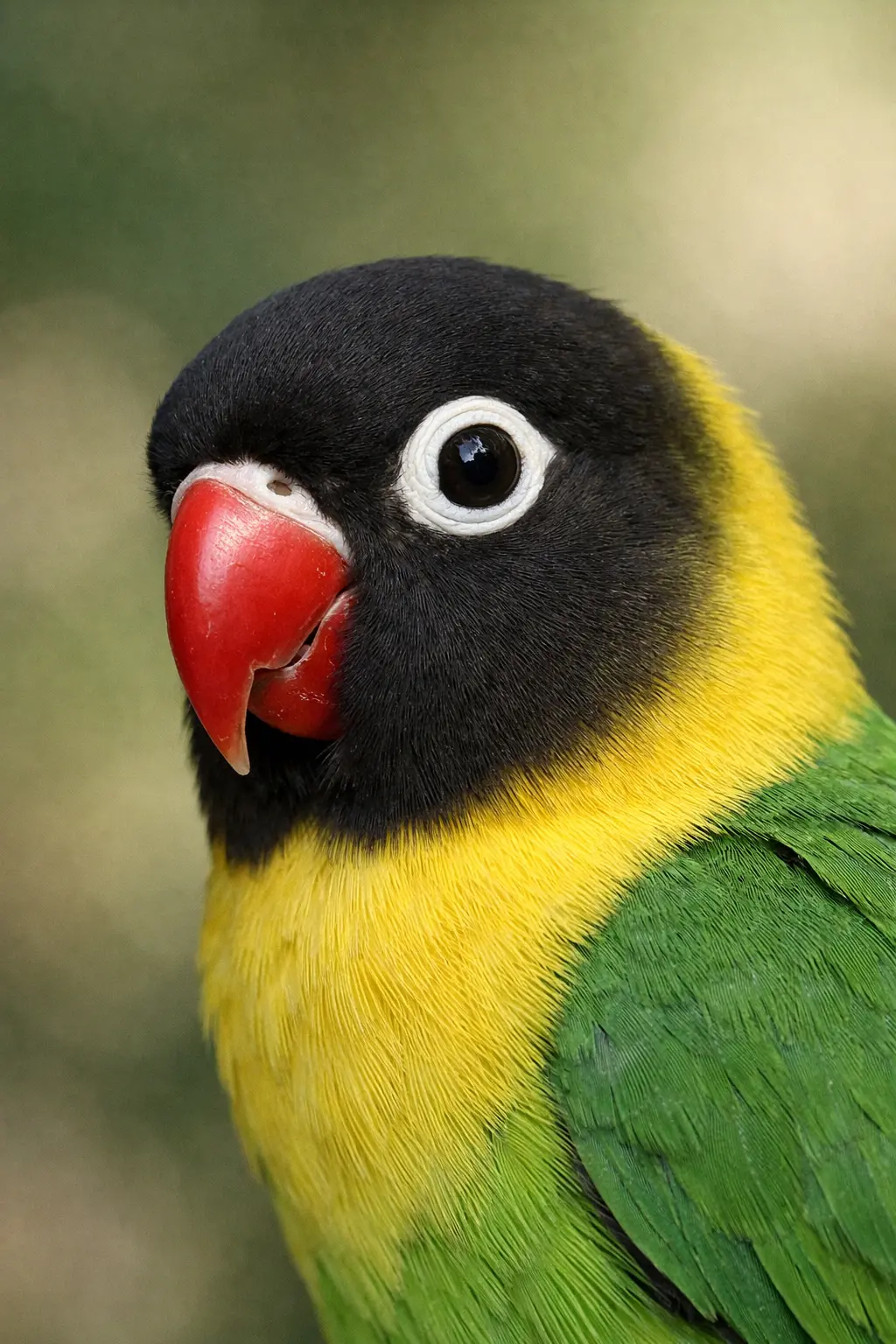
Purebred Masked Lovebird Standard: Key Characteristics
✔ Completely black mask without any brown tint
✔ Sharp transition between mask and collar
✔ Lemon-yellow chest without orange shades
✔ Clean white eye-ring (periophthalmic ring)
✔ Dark nails and grey legs
Evolution and Natural Habitat: Why the Mask?
To understand the purebred standard, we must look at where the Masked Lovebird originated. This bird hails from northeastern Tanzania, inhabiting grassy plains scattered with acacia and baobab trees. In nature, that black mask plays a crucial role in individual recognition within the flock.
Purebreds in the wild do not exhibit the variations we see in cages. The natural (wild-type) Masked Lovebird is a green bird with a black head. Any deviation from this visual identity in the wild would mean a decreased chance of mating. This "wild standard" is exactly what every serious breeder strives for—preserving that primary, powerful definition of colors.
Anatomy of a Perfect Mask: Details That Matter
When evaluating the quality of a Masked Lovebird, 50% of the score always goes to the head. The mask isn't just a "black patch"; it is a complex zone that must meet strict criteria.
1. Depth of the Black Color
In a purebred bird, the black color must be matte and deep, similar to the color of charcoal or ink. There should be no reflection of brown or grey shades. If you notice a brown tint on the back of the head under direct light, there is a high probability that the bird has Fischer's Lovebird ancestors (whose heads are naturally brownish-orange).
2. Boundaries and Symmetry
The mask must cover the entire face, forehead, crown, and nape. The lower boundary of the mask ends in a semi-circle at the throat. The greatest proof of breed purity is the sharpness of the cut. The transition from the black head to the yellow collar must not have "bleeding" zones. It must look as if someone drew a surgically precise line.
3. Eye-Ring (Periophthalmic Ring)
All eye-ring lovebirds have that white zone around the eyes, but in Masked Lovebirds, it must be particularly pronounced. The skin of the ring should be pure white, without pigmentation, creating a strong contrast with the black feathers of the head. The eyes are dark, almost black, and must be centered within the white ring.
Yellow Collar and Chest: The Zone of Truth
If the head is the "face" of the Masked Lovebird, then the chest is its "identity card." This is the part of the body where hybrids most easily "fail."
In the standard green form, the yellow color on the chest must be lemon yellow. The most common mistake is the appearance of orange pigment (known as suffusion). Even a small dot of orange on the yellow chest disqualifies the bird from exhibitions and indicates genetic mixing.
The collar must be complete. This means the yellow color extends around the entire neck, joining at the back. In poorer specimens, the collar is interrupted by green feathers at the back of the neck, which is a clear sign of weaker genetics.
Body and Wing Color: The Green Mantle
The body of a pure Masked Lovebird is dark green. The back and wings have a deep, forest green color, while the chest and belly are slightly lighter but still saturated.
- Wing Feathers: Primary flight feathers are black with green edges. When the wings are folded, they must lie flat against the body without crossing over the back.
- Tail: The tail is short and wedge-shaped. The upper side of the tail is green, while blue traces are often seen on the side feathers, which is allowed by the standard.
- Legs and Nails: Legs are grey (lead-colored). Nails must be dark grey or black. Light nails on a green bird are a red flag for an impure mutation.
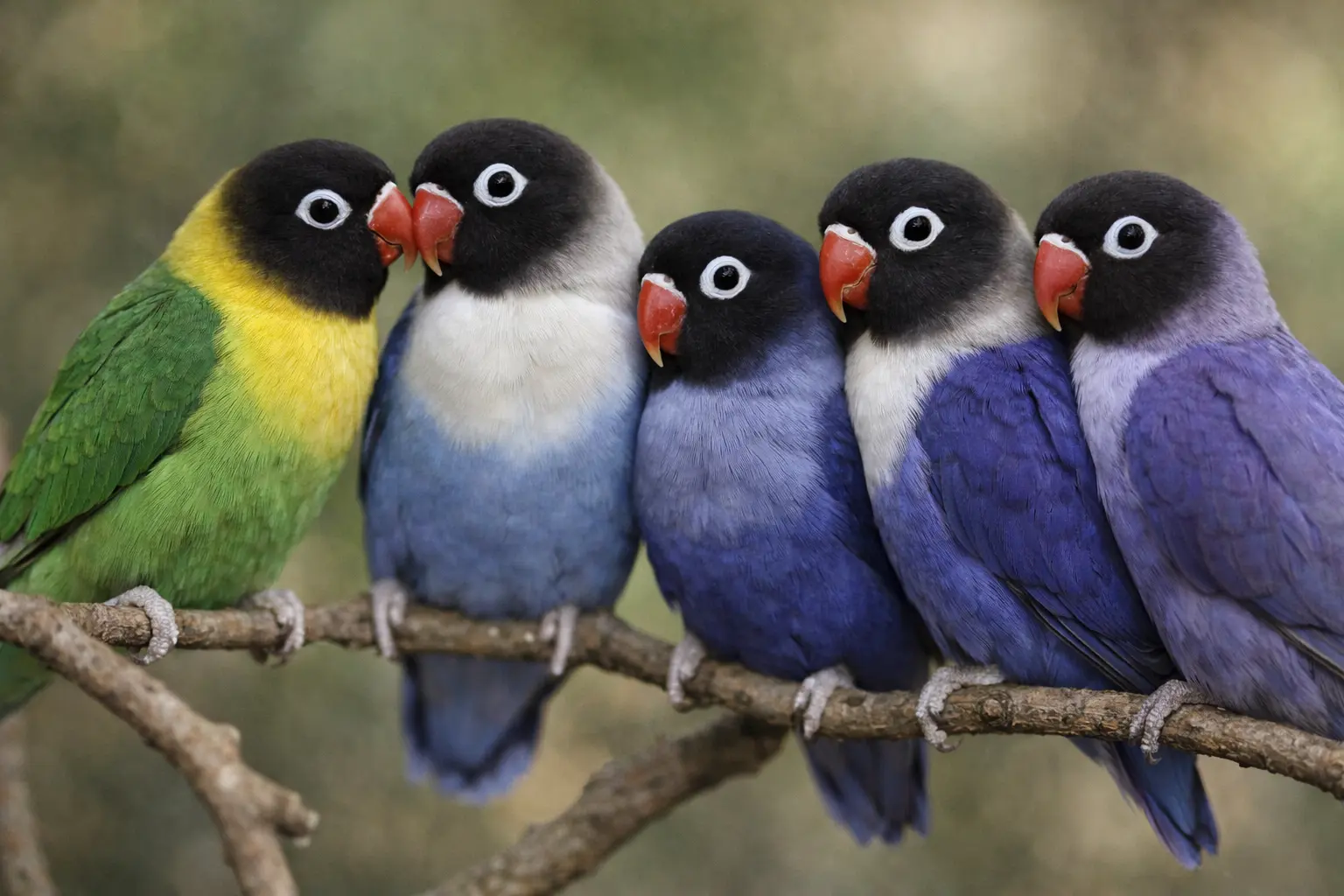
Mutations: How to Recognize Quality in Other Colors?
Today, Masked Lovebirds are available in an incredible spectrum of colors. Although mutation genetics change the base color, the mask must remain black.
Blue Masked Lovebird
This is arguably the most popular mutation. Here, the yellow collar becomes snow white, and the green body becomes sky blue.
- The Challenge: In blue birds, a "dirty" mask is most easily seen. If the white collar has greyish tints, the bird is not of top quality.
- Violet and Cobalt: These birds have even darker blue bodies. The mask on a Violet Masked Lovebird looks even more impressive due to the contrast with deep purple tones.
Dilute and Pastel Mutations
In these birds, colors are diluted. However, the goal of any serious breeder is to maintain the darkest mask possible. If the mask has become pale grey, the bird loses the typical character of a Masked Lovebird.
Nutrition and Its Impact on Mask Color
Many owners are unaware that the intensity of black and yellow colors depends directly on diet, not just genes. For your bird to have an "exhibition" shine, the diet must be rich in specific elements:
- Beta-carotene and Lutein: Although we don't want orange, natural yellow pigments from sweet corn, carrots, and dandelions help the yellow collar stay saturated and bright.
- Sulfur-containing Amino Acids: Feathers consist of keratin. Supplements containing methionine and cystine help the black mask stay thick and shiny, without pale-grey zones during molting.
- Minerals: Copper and zinc are crucial for melanin (black pigment) production. Without them, the mask will look washed out.
If you want to learn more about general care, we recommend our detailed guide on Masked Lovebirds.
The Hybridization Problem: Fischeri vs. Personatus
This is the "cancer" of modern breeding. Since these two species are very closely related, they pair easily. Their offspring are fertile but visually degraded.
How to recognize a "hidden" hybrid?
- Beak Size: Fischer's Lovebirds have slightly larger beaks. Hybrids often have disproportionately large heads or beaks relative to the body.
- Beak Color in Mutations: If a blue Masked Lovebird has reddish traces on the beak, it is a sure sign of crossbreeding.
- Temperament: Masked Lovebirds are naturally a bit more reserved and "serious." Hybrids often show the hyperactivity typical of Fischer's.
The best way to avoid buying a hybrid is to visit professional bird shows. On our site, we regularly update the calendar of small animal fairs and exhibitions in Serbia, where you can contact breeders who have preserved pure lines for decades.
Housing That Preserves the Breed's Beauty
A cage for a Masked Lovebird must be spacious enough to prevent damage to the tail feathers. A bird with a broken tail loses its aesthetic value.
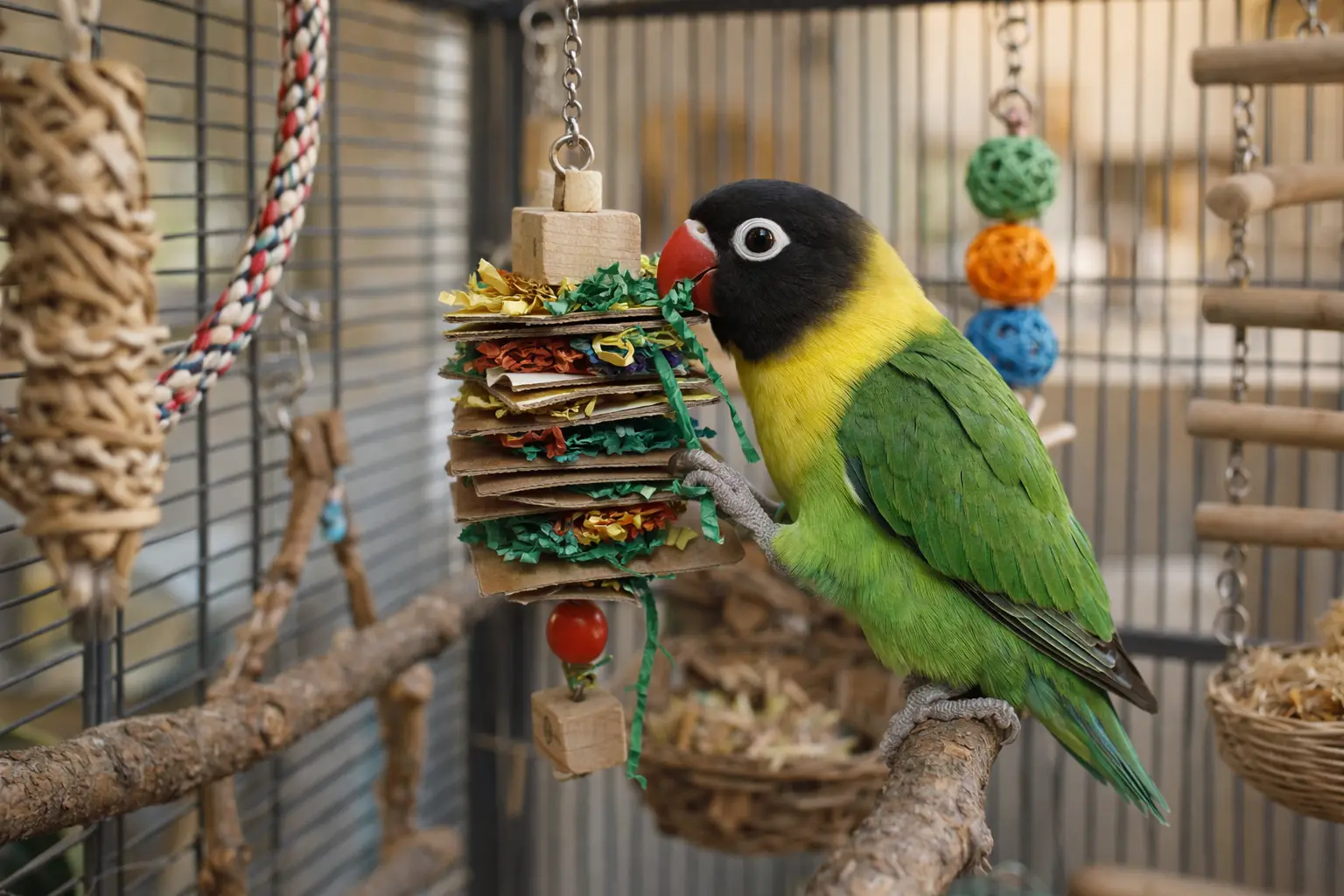
- Natural Wood Perches: Branches of varying thickness (hazel, apple) help wear down nails, which must be neat and dark in Masked Lovebirds.
- Lighting: Full-spectrum UV lamps are necessary for indoor birds. They allow the bird to synthesize vitamin D3 and see colors in their full glory, which is crucial for social interaction within a pair.
Conclusion: Investing in Purity
Whether you are buying a Masked Lovebird as a pet or for breeding, knowing the standards will help you appreciate nature's effort more. Purebred status is not just about prestige at shows; it is about preserving biodiversity in our homes. A Masked Lovebird with a perfect black mask and lemon-yellow collar is a living work of art that, with proper care, can grace your life for up to 15 years.
Be patient when choosing, observe the details, and always look for a bird that "pops" with health and color.
Frequently Asked Questions
Why does my Masked Lovebird have a brown head?
If the bird is young, this is normal. The mask completely "clears up" and becomes black only after 8-10 months of age. If an adult bird is still brownish, it is likely a hybrid with a Fischer's Lovebird.
Can Masked Lovebirds be kept in a flock?
Yes, Masked Lovebirds are very social and enjoy the company of their own kind in large aviaries. However, during the breeding season, they can become aggressive toward other pairs in the fight for nesting boxes.
What is the character difference between a Masked Lovebird and a Peach-faced Lovebird?
Masked Lovebirds are considered slightly calmer and less destructive than Peach-faced Lovebirds, but they are still very intelligent and require plenty of chew toys.
How do I know if my Masked Lovebird is male or female?
Visually, it is impossible to determine with 100% certainty. Females are often slightly larger and have wider pelvises, but the only certain way is DNA analysis from a drop of blood or a feather.
