Indian Ringneck Intelligence: Speech, Training, and Lifespan
The Indian Ringneck Parakeet (Psittacula krameri) is one of the most fascinating examples of evolutionary adaptability and cognitive complexity in the world of medium-sized parrots. While many choose them for their exotic looks and elegant silhouette, the true value of this bird lies in its "processor."
In avian circles, the Indian Ringneck (IRN) is often called the "feathered engineer" due to its innate need to explore, dismantle, and understand the world around it.
In this guide, we will explore the depths of their intelligence, analyze why owner experiences vary so much, and learn how to properly channel their high energy through training and enrichment.
Why are Indian Ringnecks So Smart?
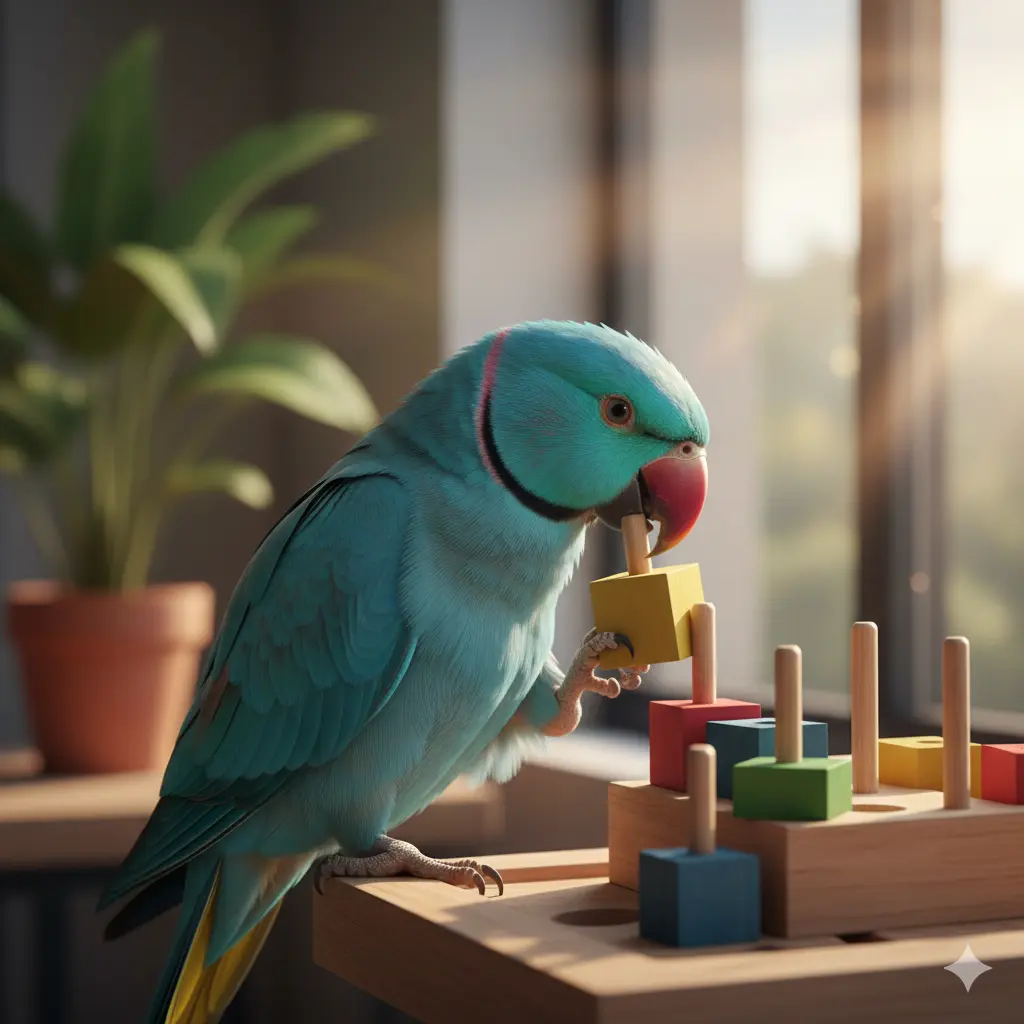
To understand why your Indian Ringneck talks or solves complex puzzles, we have to look at their origins. Unlike many other parrots, IRNs have successfully adapted to urban environments worldwide. This ability to adapt requires a high level of cognitive flexibility.
Their brains have a high density of neurons in areas responsible for communication and object manipulation. This means they don't just react on instinct; they are capable of "insight learning"—the ability to solve a problem on the first try through pure observation.
Is an Indian Ringneck Just Mimicking, or are They "Talking"?
If you expect your parrot to just repeat words like a broken record, the Indian Ringneck will quickly prove you wrong.
The question "Do Indian Ringnecks talk?" is actually the wrong one. The real question is: How much do they actually understand us? Unlike many other birds, these parrots don't just "rattle off" words—they use them with intent.
Crystal Clear Diction: Masters of Consonants
What fascinates anyone hearing a clear IRN for the first time is their diction. Indian Ringnecks have an incredible gift for pronouncing sharp consonants. When they say "Good morning," it doesn't sound like a bird chirp; it sounds like a high-pitched, slightly metallic human voice.
While there is a myth that only males are talented (because they "woo" females with song in the wild), the truth is that females are also serious talkers. The difference is mainly temperament—a male might chatter just to be the center of attention, while a female often learns specific words to get exactly what she wants in that moment.
When a Parrot Becomes a "Conversationalist"
The greatest charm of IRN intelligence is associative speech. This isn't empty mimicry; it’s functional communication.
Many owners share similar experiences: your pet likely won't say "Give me an apple" while playing in the cage, but they might scream it the second they see you approaching the refrigerator. They don't just learn the sound of the word; they learn the situation that accompanies it. This spark of intelligence allows them to connect your behavior with their vocabulary, turning imitation into a basic but fascinating dialogue.
Colors and Mutations: The Blue Indian Ringneck Personality
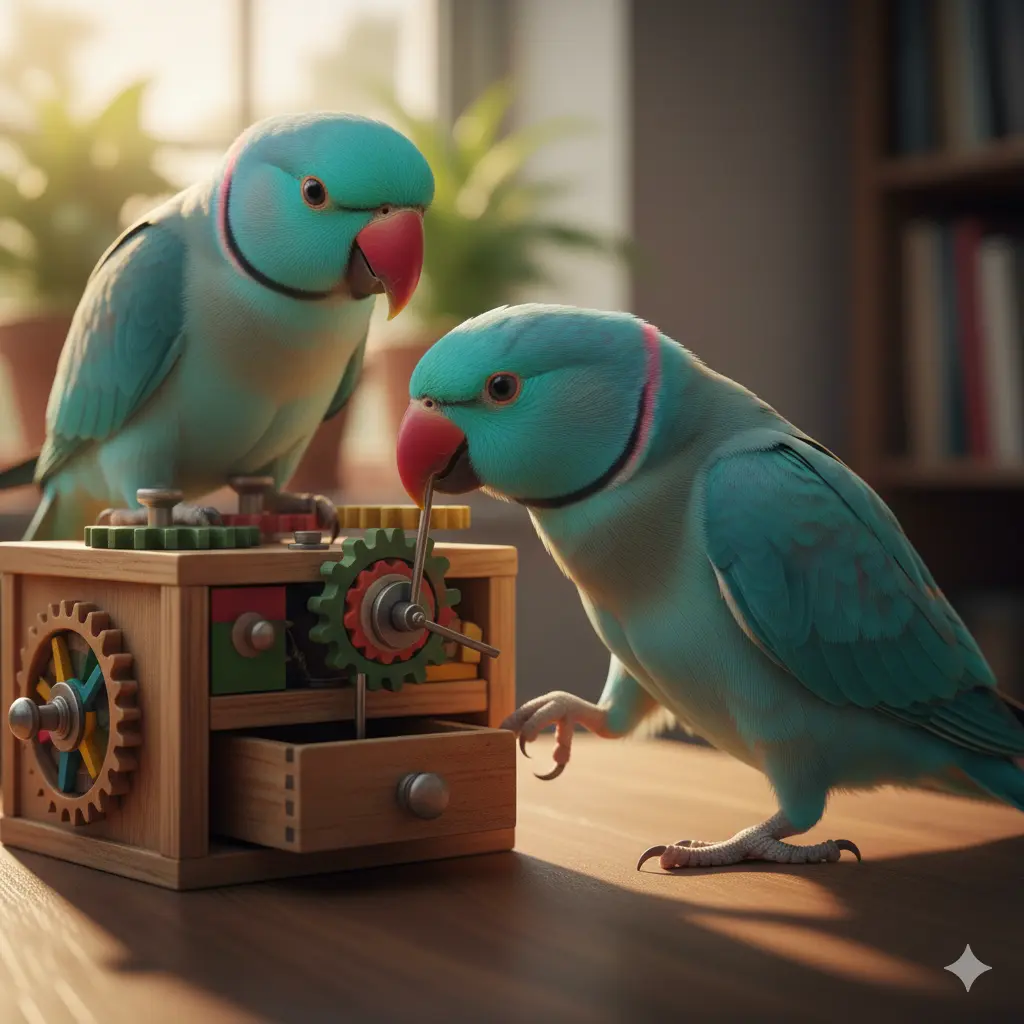
In the pet trade, people often ask if color affects behavior. The Blue Indian Ringneck is currently one of the most sought-after mutations due to its stunning azure plumage.
- Genetics and Character: Scientifically, feather color does not change brain structure. However, because blue or Lutino (yellow) birds are in high demand, they are often captive-bred and hand-fed, making them tamer and more eager to learn than wild-caught counterparts.
- Price vs. Value: When considering the price of an Indian Ringneck, mutations are always more expensive. But remember, you are paying for the look—intelligence is "standard equipment" on every model, regardless of color.
The Importance of Diet for Brain Function
While this guide focuses on intelligence, it's vital to note that a parrot's brain consumes a massive amount of energy. A bird fed only on a plain seed mix won't have the mental capacity for complex tricks or speech. For peak cognitive results, your pet requires a balanced intake of vitamins, minerals, and healthy fats.
Important Note: You can find a detailed meal plan, a list of safe fruits and vegetables, and dangerous foods in our dedicated guide: Indian Ringneck Nutrition.
Lifespan and Long-Term Commitment
When planning to get an IRN, you must be aware of their impressive lifespan. In optimal conditions, these birds live between 25 and 30 years. Some documented cases even mention birds reaching 40.
This means you aren't just buying a pet; you're gaining a lifelong companion. Their intelligence doesn't fade with age; they become wiser and more deeply connected to their owner’s routine. Because of this longevity, mental stimulation is key—a bird kept in a boring environment for 20 years will develop serious psychological issues.
Practical Exercises for Mental Stimulation (Foraging)
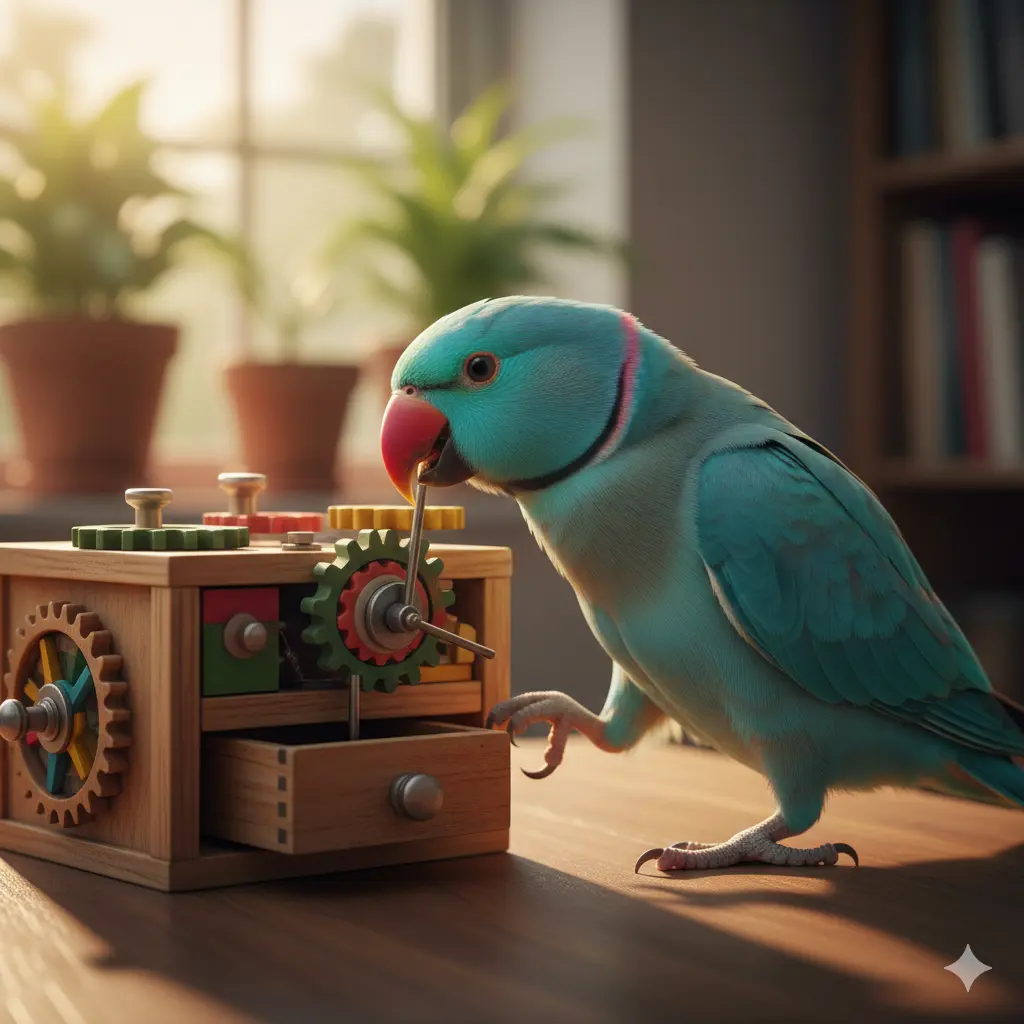
Foraging is a term every IRN owner must master. It is the process of "working for food." In the wild, they don't find a bowl of food; they have to fly miles and peel bark to find a meal.
How to Implement Foraging:
- Level 1 (Beginner): Wrap a favorite treat in plain white paper. The bird must unwrap and shred the paper to get the reward.
- Level 2 (Intermediate): Use plastic or wooden boxes with small holes. The bird must shake the box or turn it at a specific angle for the food to fall out.
- Level 3 (Advanced): Nuts and bolts. Indian Ringnecks are masters of unscrewing. There are toys where they must unscrew a lid to reach a walnut.
Training Your Indian Ringneck
Intelligence can become destructive if not channeled. Training isn't just about party tricks; it's a way to prevent bird frustration.
Clicker Training
IRNs respond excellently to the sound of a clicker. It gives them instant feedback that they did something right. Start with "target training"—teach the bird to touch the tip of a stick with its beak for a reward. This is the foundation for complex tricks, like fetching items.
Solving Destructive Behavior
If your parrot is chewing your furniture, they are telling you: "I'm bored, and this cabinet has a cool texture." Instead of punishment (which doesn't work with parrots), offer an alternative—fresh bird-safe branches (apple, hazelnut) to chew on. Their need to use their beak is a biological imperative.
Common Owner Questions
Are Indian Ringnecks aggressive?
They go through a phase known as "bluffing" during puberty (around age one). They can become willful and try to bite. With patience and consistent training, this phase passes. Their "aggression" is often just misunderstood intelligence or fear.
How to tell a male from a female before age two?
Visually, it’s nearly impossible without a DNA test (from a blood drop or feather). Males don't get their signature ring until their second or third year. Until then, behavior (males "dance" more often and flare their wings in a heart shape) is the only clue.
Can they live with other birds (like Cockatiels)?
IRNs are dominant and can be aggressive toward smaller birds. Use extreme caution and constant supervision if they are in the same room. Never house them in the same cage as other species due to the risk of injury.
Conclusion: Is This the Right Bird for You?
The Indian Ringneck is a "high-maintenance" pet when it comes to mental engagement. If you want a bird that just sits in the corner as decoration, this isn't the choice for you. But if you want a partner who will make you laugh with their antics, amaze you with their vocabulary, and be your companion for 30 years, you're in for an incredible adventure.
Your job as an owner is to be a "flock leader" who constantly sets new challenges. With love, patience, and daily work, there are practically no limits to what this bird can learn.
